What Security Leaders Must Do Next
Ransomware is no longer a slow‑burn, multi‑week operation. In April 2026, threat intelligence confirms that modern ransomware campaigns routinely progress from initial access to data encryption in hours, sometimes within a single business day. Attackers are exploiting freshly disclosed vulnerabilities before patches are widely deployed, chaining them with stolen credentials and automated lateral movement to outpace detection and response.
For security teams, this shift is forcing a hard truth: traditional security controls, quarterly testing, and reactive incident response plans are no longer sufficient. Organizations that assume they will have “time to respond” are already behind.
Nervous yet? Read on to see why ransomware kill chains have collapsed, how attackers are achieving unprecedented speed, what this means for operational risk and cyber insurance, and —most importantly— what organizations must change now to remain resilient.
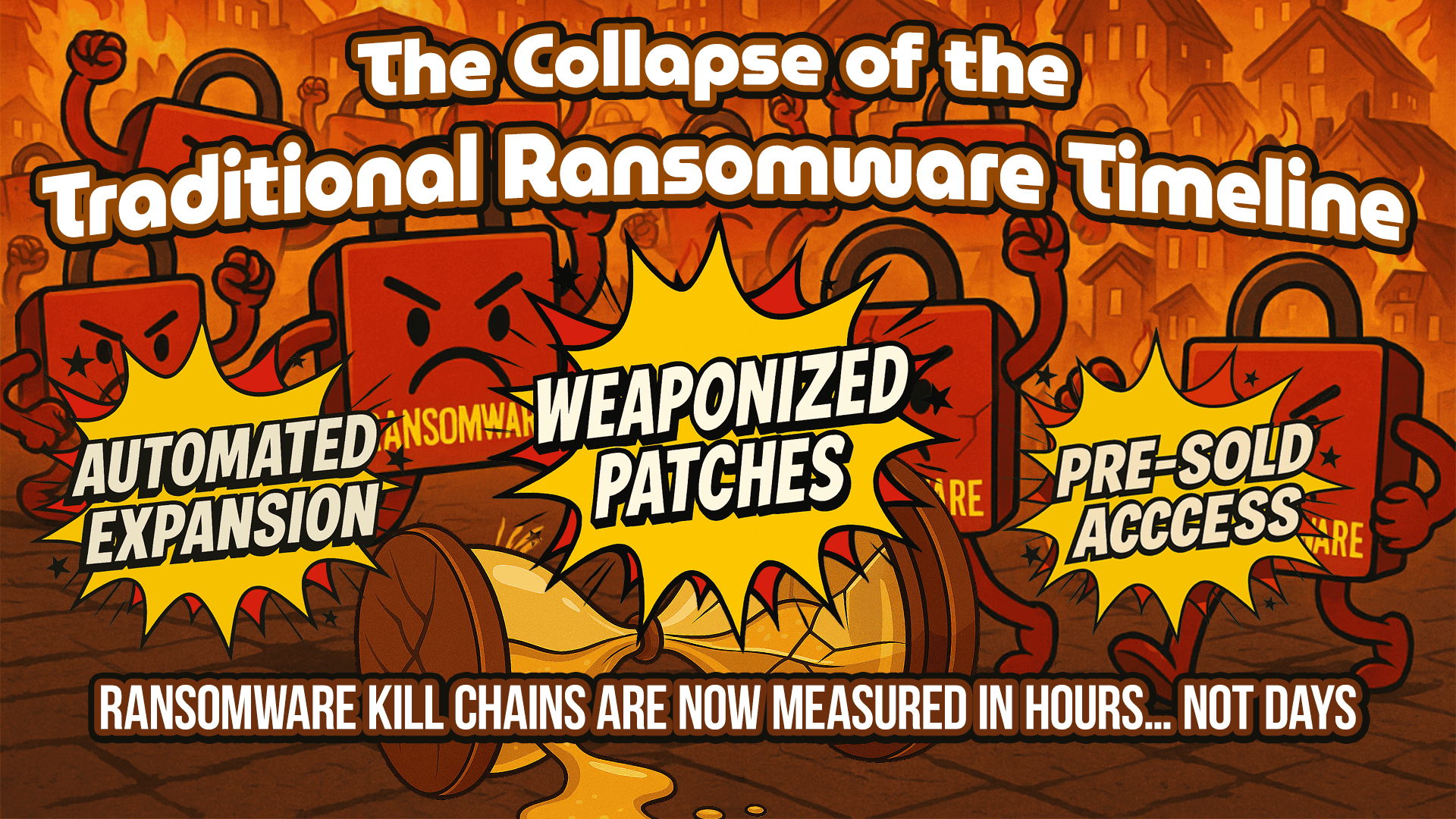
The Collapse of the Traditional Ransomware Timeline
For years, ransomware followed a familiar pattern:
- Initial access (often phishing or RDP)
- Persistence and reconnaissance over days or weeks
- Credential harvesting and lateral movement
- Privilege escalation
- Payload staging
- Encryption and extortion
That model assumed attackers needed time… That assumption no longer holds.
What Changed?
Recent campaigns show attackers compressing this entire chain into hours, driven by three converging forces:
- Rapid vulnerability weaponization
- Automation of lateral movement and privilege escalation
- Pre‑built access purchased from initial access brokers (IABs)
Microsoft Threat Intelligence and multiple industry reports confirm ransomware operators —particularly China‑linked and financially motivated groups— are deliberately targeting the patch adoption gap, striking systems within days or even hours of CVE disclosure.
Vulnerability Speed: Patch Tuesday Is Now a Starting Gun
April 2026 Patch Tuesday was one of the largest ever, addressing over 165 vulnerabilities, including zero‑days already under active exploitation. For attackers, Patch Tuesday isn’t a warning… it’s a target list.
Why Speed Favors Attackers
- Security teams need testing windows, approvals, and change freezes
- Attackers need one exposed system
- Public exploit code is often available before enterprises complete risk reviews
Threat groups have been observed scanning for unpatched systems within hours of disclosure, particularly for:
- VPN gateways
- Remote management tools
- File transfer services
- Identity platforms
- Collaboration tools (ie: SharePoint)
Once exploited, attackers rarely pause to recon anymore. Automation handles the rest.
Automation Has Replaced Exploration
Modern ransomware operators no longer “explore” environments manually. Instead, they deploy automated playbooks immediately after gaining access.
Automated Actions Observed in Recent Campaigns
- Instant credential dumping
- Cached token harvesting
- Automated domain enumeration
- Rapid deployment of legitimate admin tools (LOLBins)
- Scripted lateral movement via RMM or PowerShell
- Privilege escalation using publicly known EoP flaws
These steps now occur concurrently, not sequentially.
Microsoft and security researchers have documented ransomware actors completing full domain compromise and encryption within hours of exploiting exposed systems.
Initial Access Is Often Not the First Step
One uncomfortable reality for SMBs: the breach may already exist before the attack begins.
The Role of Initial Access Brokers (IABs)
Ransomware operators frequently purchase:
- VPN credentials
- RDP access
- SaaS admin logins
- Session tokens
- Cloud IAM access
These credentials may have been stolen weeks —or months— earlier via phishing, malware, or credential stuffing. When the ransomware operator buys access, the kill chain starts already inside the network.
This explains why many businesses report “no warning signs” before encryption.
Why EDR Alone Is No Longer Enough
Endpoint Detection and Response (EDR) remains important… but it is not a ransomware prevention strategy by itself.
The Problem
- Many ransomware actions use legitimate tools
- Attack chains increasingly resemble normal admin behavior
- Encryption often occurs after domain admin privileges are obtained
- Alerts arrive after irreversible damage is done
Attackers deliberately blend into standard IT operations, knowing SOC teams are overwhelmed by noise.
What This Means for SMB Executives and Boards
For SMB leadership, the operational impacts are severe:
- Downtime measured in weeks
- Data exfiltration and regulatory exposure
- Insurance denials for “inadequate controls”
- Customer trust erosion
- Executive accountability
Cyber insurance carriers are already adjusting underwriting requirements to reflect these faster kill chains, demanding demonstrable controls — not policy documents alone.
The New Definition of “Ransomware Readiness”
Ransomware readiness in 2026 is no longer about preventing every intrusion. It is about limiting blast radius and recovery time.
Organizations That Recover Faster Share These Traits
- Up‑to‑date external attack surface inventories
- Prioritized vulnerability remediation tied to exploitation likelihood
- Documented, tested incident response plans
- Immutable, segregated backups
- Privileged access controls that slow lateral movement
- Executive‑level cyber governance
Anything less is assumed compromised.
What MSPs Must Rethink Right Now
MSPs sit on the front line of this reality.
Key MSP Risks
- Single tool stacks across many clients
- Shared admin credentials
- Delayed patch cycles for “stability”
- Overreliance on antivirus and backups
A compromise at one client can rapidly escalate to reputational or contractual risk across the MSP’s entire customer base.
The vCISO Advantage in a Compressed Kill Chain World
vCISO services are uniquely positioned to address this shift… not with tools, but with decision frameworks.
Where vCISOs Deliver Immediate Value
- Risk‑based patch prioritization
- Security governance aligned to business operations
- Incident response readiness assessments
- Third‑party and MSP risk oversight
- Cyber insurance readiness validation
Executives don’t need more alerts—they need clear decisions made faster than attackers move.
Three Immediate Actions Organizations Must Take
1. Validate External Exposure Continuously
You cannot protect what you don’t know is exposed.
What to do now:
- Continuous attack surface monitoring
- Internet‑facing asset inventories
- Validation of SaaS, VPN, and RMM exposure
Schedule an External Attack Surface & Penetration Test to identify exploitable exposures before adversaries do.
2. Assume Breach… and Plan Accordingly
Incident response plans written years ago assume timelines that no longer exist.
What to do now:
- Conduct ransomware tabletop exercises
- Validate decision‑making authority
- Test backup restoration under pressure
- Align legal, IT, and executive response paths
Book an Incident Response Readiness Assessment or Tabletop Exercise tailored to your environment.
3. Align Security With Compliance and Insurance Reality
Frameworks like NIST CSF, CIS Controls, SOC 2, HIPAA, and ISO 27001 increasingly influence claim outcomes and regulator scrutiny.
What to do now:
- Map real controls—not aspirational ones
- Identify gaps insurers already penalize
- Prioritize controls that limit ransomware spread
Request a Compliance‑Aligned Security Gap Assessment to reduce regulatory and financial exposure.
Why Speed Is Now the Ultimate Security Metric
In past years, security maturity was measured by prevention. In 2026, it is measured by time:
- Time to detect
- Time to decide
- Time to contain
- Time to recover
Attackers are operating at machine speed. Defenders must respond with pre‑approved authority, tested plans, and visibility that exists before an incident begins.
Final Thought: This Is Not an IT Problem
Ransomware kill chains shrinking from days to hours is not a technical failure — it is an organizational readiness challenge.
Organizations that survive ransomware incidents do not “get lucky.” They make faster decisions because strategy, governance, and execution were aligned before the breach.
The question is no longer if an attacker will get in… but how much of your business they can take with them when they do.
Ready to Act?
If you’re an MSP, vCISO, or SMB leader:
- Identify exploitable gaps before attackers do
- Prepare executives for real‑world ransomware decisions
- Align security controls with compliance and insurance expectations
Contact us today to discuss penetration testing, incident response readiness, or vCISO services designed for the realities of ransomware in 2026.