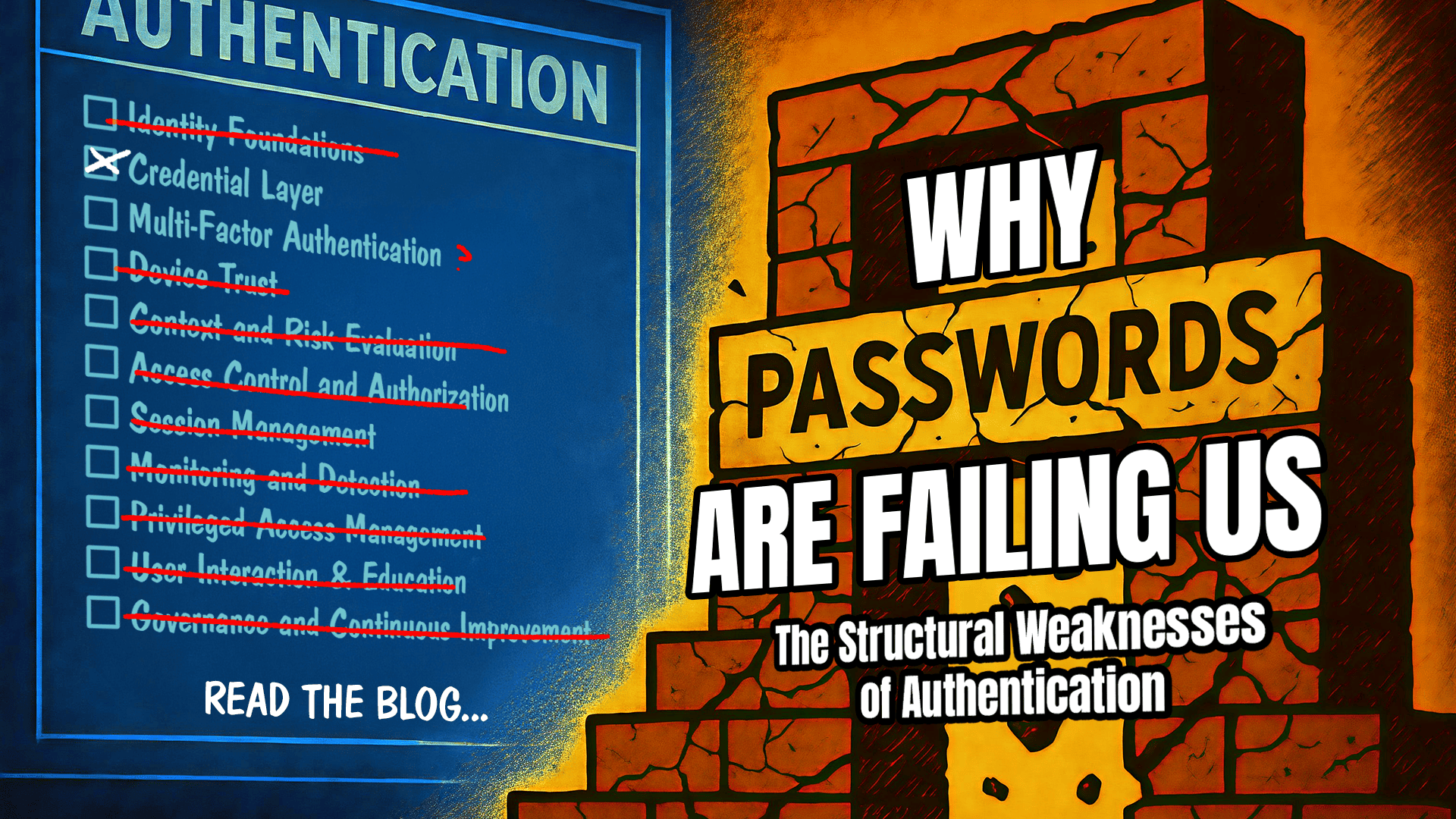
Passwords remain the most common authentication method across organizations of every size. However, they also represent one of the most persistent points of failure in modern security programs. Despite decades of policy refinement, user training, and technical controls, password-based authentication routinely enables breaches, account compromise, and lateral movement. This reality raises an important question: why do passwords continue to fail?
The issue is not that passwords are inherently broken. Instead, password-based security depends on consistent human behavior in environments where consistency is difficult—if not impossible—to enforce at scale. As long as passwords remain the primary authentication mechanism, organizations will continue to carry risk that policy alone cannot eliminate.
This article explains why passwords fail in real-world environments, how attackers exploit their weaknesses, how operational practices amplify risk, and why organizations often misunderstand or misapply frameworks such as NIST. Finally, it outlines practical steps organizations can take to reduce reliance on passwords while improving overall authentication resilience.
Passwords Depend on Human Behavior, Not System Control
At their core, passwords shift responsibility from systems to users. Organizations can define password requirements—length, complexity, and expiration—but they cannot fully control how users create, reuse, store, or protect credentials.
Most enterprise environments still rely on passwords as the primary authentication method. Even when additional controls exist, passwords often serve as the initial gatekeeper. As a result, guessed, captured, or reused credentials immediately expose the environment to risk.
From a systems perspective, passwords offer limited control. Once a valid username and password combination is presented, the authentication system generally cannot determine whether a legitimate user or an attacker is attempting access. Without additional context, the system simply accepts the login.
Consequently, passwords appeal to attackers. They provide direct access without exploiting vulnerabilities, misconfigurations, or software flaws. Rather than attacking systems, attackers focus on the authentication process itself.
Credential Management Breaks Down at Scale
Modern users interact with dozens—sometimes hundreds—of systems, each with its own authentication requirements. Organizations often expect users to manage these credentials securely and consistently.
In practice, this expectation fails.
Password Reuse and Variation
Users routinely reuse passwords across multiple systems, especially when they need to remember credentials without assistance. When organizations discourage reuse, users often respond by creating minor variations—changing one character, appending a number, or incrementing a sequence.
Although these variations satisfy policy requirements, they provide little real security benefit. From an attacker’s perspective, knowledge of one password often simplifies guesses for the rest.
Unsecured Storage
To manage password overload, users frequently store credentials in unsecured locations, including:
- Notes applications
- Spreadsheets
- Email drafts
- Sticky notes
- Browser autofill without protection
Each practice creates additional attack paths unrelated to the original authentication system.
Predictable Compliance
Complexity requirements often lead to predictable behavior. Users meet policy requirements by capitalizing the first letter, appending a symbol, or adding numbers at the end of familiar words. Attackers fully understand these patterns and incorporate them into automated tools.
As a result, password policies may appear strong on paper while producing weak passwords in practice.
Why Attackers Focus on Credentials
Valid credentials offer one of the fastest paths to access. Once attackers obtain them, most security controls assume legitimacy.
Attackers adjust their methods based on environmental controls, access value, and visibility. Several common techniques illustrate why passwords remain a primary target.
Credential Stuffing: Reuse as an Entry Point
Credential stuffing exploits widespread password reuse. After attackers obtain credential pairs through unrelated breaches, they test those combinations across other systems.
Because this method is highly automated and scalable, attackers avoid guessing entirely. Instead, they test known credentials against:
- Email portals
- VPNs
- Cloud services
- SaaS platforms
- Customer-facing login pages
Even a low success rate yields meaningful access at scale. One reused password can trigger multiple compromises.
Password Spraying: Finding Weaknesses Without Lockouts
Password spraying takes the opposite approach. Rather than trying many passwords against one account, attackers try one or two common passwords across many accounts.
This strategy avoids lockout thresholds and monitoring alerts. It works especially well in environments with:
- Weak password policies
- Newly created accounts
- Temporary or seasonal users
- Default or baseline credentials
Because each account sees minimal failures, defenders often detect spraying only after access is established.
Targeted Guessing With Public Information
Attackers also use publicly available data to tailor guesses. Names, job roles, and organizational terminology improve guess accuracy. Social media, company websites, and prior breaches provide valuable context.
Unfortunately, password policies sometimes reinforce these patterns by requiring numbers, capital letters, or frequent changes. Predictable rules make targeted guessing easier, not harder.
Phishing: Still Highly Effective
Phishing remains one of the most reliable credential theft techniques. Attackers create convincing login prompts and rely on urgency or context to elicit responses.
Modern phishing campaigns frequently involve:
- Cloud-hosted lookalike login pages
- OAuth consent abuse
- Real-time credential harvesting
- MFA fatigue attacks
Once attackers capture credentials, they may use them immediately or store them for later. Even with multi factor authentication in place, attackers increasingly find ways to bypass or abuse it.
Malware, Keylogging, and Session Theft
Endpoint compromise changes the attack model entirely. Malware and keyloggers capture credentials during normal use without alerting the user.
Beyond passwords, attackers now prioritize session tokens. A stolen token can provide access without requiring password re-entry, sometimes even after a password change. This reality further undermines the assumption that passwords alone offer meaningful protection.
Offline Cracking After Hash Exposure
When attackers obtain password hashes, they often shift to offline cracking. This approach eliminates interaction with the authentication system and allows unrestricted guessing using powerful hardware.
Cracking feasibility depends on:
- Hashing algorithms
- Salting practices
- Iteration counts
- Available compute resources
Weak configurations enable attackers to recover passwords quickly, especially when users choose predictable combinations.
Operational Practices That Increase Risk
Even strong policies can fail due to everyday operational decisions.
Password Expiration and Predictable Changes
Forced rotation often encourages incremental changes rather than new passwords. Users modify a single digit or character to comply, creating patterns attackers readily exploit.
Although expiration appears protective, it frequently increases predictability while frustrating users.
Convenience-Driven Lockout Policies
To limit support tickets, some organizations relax lockout thresholds. Without compensating controls, these decisions weaken defenses against automated attacks.
Shared and Unmanaged Service Accounts
Teams often share service or administrative accounts, rotate them infrequently, and monitor them poorly. These accounts usually hold elevated privileges, making them particularly attractive targets. Once compromised, they often enable long-term, low-visibility access.
Multi Factor Authentication Helps—When Applied Correctly
Multi factor authentication (MFA) significantly reduces damage from password compromise. However, its effectiveness depends on coverage and configuration.
In many organizations, MFA protects only:
- Remote access
- Administrative accounts
- Select privileged systems
Meanwhile, internal apps, legacy platforms, and user-facing services continue to rely on passwords alone. Attackers routinely exploit these gaps.
Additionally, MFA without contextual evaluation, device signals, or session controls remains vulnerable to phishing and token theft.
Why NIST Guidance Is Often Misunderstood
Organizations frequently reference NIST SP 800-63 when designing password policies, especially minimum length requirements. Problems arise when teams adopt guidance selectively.
NIST does not present isolated controls. Instead, it defines an integrated system of protections that reinforce one another, including:
- Multi factor authentication
- Rate limiting and automation protection
- Authentication monitoring
- Context-based access evaluation
- Secure credential storage
Removing any element weakens the overall model.
When Partial Adoption Increases Risk
Adopting shorter passwords without MFA, monitoring, and rate limiting reduces security rather than improving it. NIST expects these controls to operate together.
Ultimately, identity security must function as a system—not a collection of disconnected settings.
Reducing Reliance on Passwords
Reducing reliance on passwords offers a more sustainable security path.
Effective strategies include:
- Expanding MFA coverage across all authentication flows
- Adopting passwordless authentication where feasible
- Implementing conditional access controls
- Evaluating device posture, location, and behavior
These measures limit exposure even when credentials are compromised.
Improving Credential Management Discipline
Passwords will remain in most environments for the foreseeable future. Organizations reduce risk by enforcing consistent credential management.
Recommended practices include:
- Unique credentials for every system
- Enterprise-approved password managers
- Defined ownership for privileged accounts
- Scheduled rotation of service accounts
- Continuous monitoring of authentication activity
Credential management is not solely a user responsibility—it is an organizational one.
Training Users as Part of the Control Set
User training still matters, but expectations must remain realistic. Training should emphasize:
- Phishing and social engineering recognition
- Legitimate versus suspicious authentication prompts
- Prompt reporting of unusual activity
Training succeeds only when technical controls reinforce it.
Passwords as One Control, Not the Foundation
Passwords will not disappear overnight. Security improves when organizations treat them as one element of a broader authentication strategy rather than the foundation of identity security.
Organizations that rely exclusively on passwords remain exposed to predictable, automated attacks.
Practical Checklist for Maintaining Password Security
- Use password managers to generate and store unique passwords
- Enforce MFA for remote access, email, and administrative accounts
- Review and disable unused accounts
- Implement lockouts or rate limiting
- Monitor for credential stuffing and spraying patterns
- Use strong hashing algorithms and secure configurations
- Restrict shared accounts and assign clear ownership
- Rotate service account credentials on a defined schedule
- Apply conditional access for high-risk locations
- Train users to identify phishing and abnormal login prompts
- Audit policies to avoid predictable patterns
Conclusion: The Path Forward
Passwords fail not because organizations lack policies, but because password-based authentication imposes unrealistic expectations on users while offering limited system-level assurance. Attackers understand this imbalance and exploit it at scale.
By reducing reliance on passwords, layering authentication controls, and treating identity security as a cohesive system, organizations achieve durable, measurable risk reduction.
Passwords still exist—but they should no longer carry security on their own.
How’s your security hygiene? Let us test it for you.