The Cybersecurity Reality Behind Smartphone Surveillance
By design, cybersecurity discussions often begin with intrusion: malware, exploits, nation-state operators lurking in the shadows. But what if the real threat isn’t hiding in your system…because it was never “outside” to begin with?
The Myth of the Hack
In cybersecurity, language matters.
Many times in conversation, we’ve had users say,“I think my phone was hacked,” but what they usually mean is:
- An ad appeared uncannily relevant (ie: “OMG I was talking out loud with someone about taking a cruise and then I started receiving ads about cruises!”)
- Their location seemed exposed (ie: “I’m was in a different city for work and started to see ads for 10% off at a coffee place DOWN THE STREET on social media!”)
- Their device behaved “creepily” but not maliciously (ie: “I got into my vehicle and the Maps App told me how long it would take to get to where I am going… but I didn’t say where I was going yet!”)
From a technical standpoint, that’s rarely a compromise. It’s visibility.
We’ve conditioned users—and in some ways, entire organizations—to associate risk with breach-based events: malware payloads, command-and-control callbacks, privilege escalation. These are real threats. But they are not the most common.
The uncomfortable truth is this:
Most smartphone “surveillance” today is not the result of hacking. It is the result of participation in a data economy designed to observe, collect, and monetize behavior at scale.
And that distinction fundamentally changes how we think about risk.
The Architecture of Observation
To understand why this matters, you need to understand the architecture behind it.
Modern smartphones are not just endpoints. They are sensors.
Every application, permission, and background process contributes to a continuous data stream.
Consider the scale:
- 92% of mobile apps collect some form of user data, including location, contacts, or behavioral telemetry [worldmetrics.org]
- At least 40,000 apps worldwide are actively collecting location data and feeding it into data broker ecosystems [heise.de]
- In many cases, apps collect significantly more data than they disclose—up to 76% of Android apps gather precise location data even when only 42% declare it [cio.inc]
This isn’t a vulnerability. It’s the baseline.
Behind every app experience is a network of third-party SDKs—advertising libraries, analytics modules, telemetry pipelines. These components extract data points such as:
- GPS coordinates
- Device identifiers (Advertising IDs, IP addresses)
- Usage patterns and behavioral signals
- Demographic inferences
The result is not a simple dataset. It’s a persistent behavioral model.
And it’s being built continuously.
The AdTech Engine: Surveillance Without Exploitation
At the center of this ecosystem is adtech—the digital engine that powers targeted advertising. It is also, increasingly, the infrastructure for surveillance.
Here’s how it works:
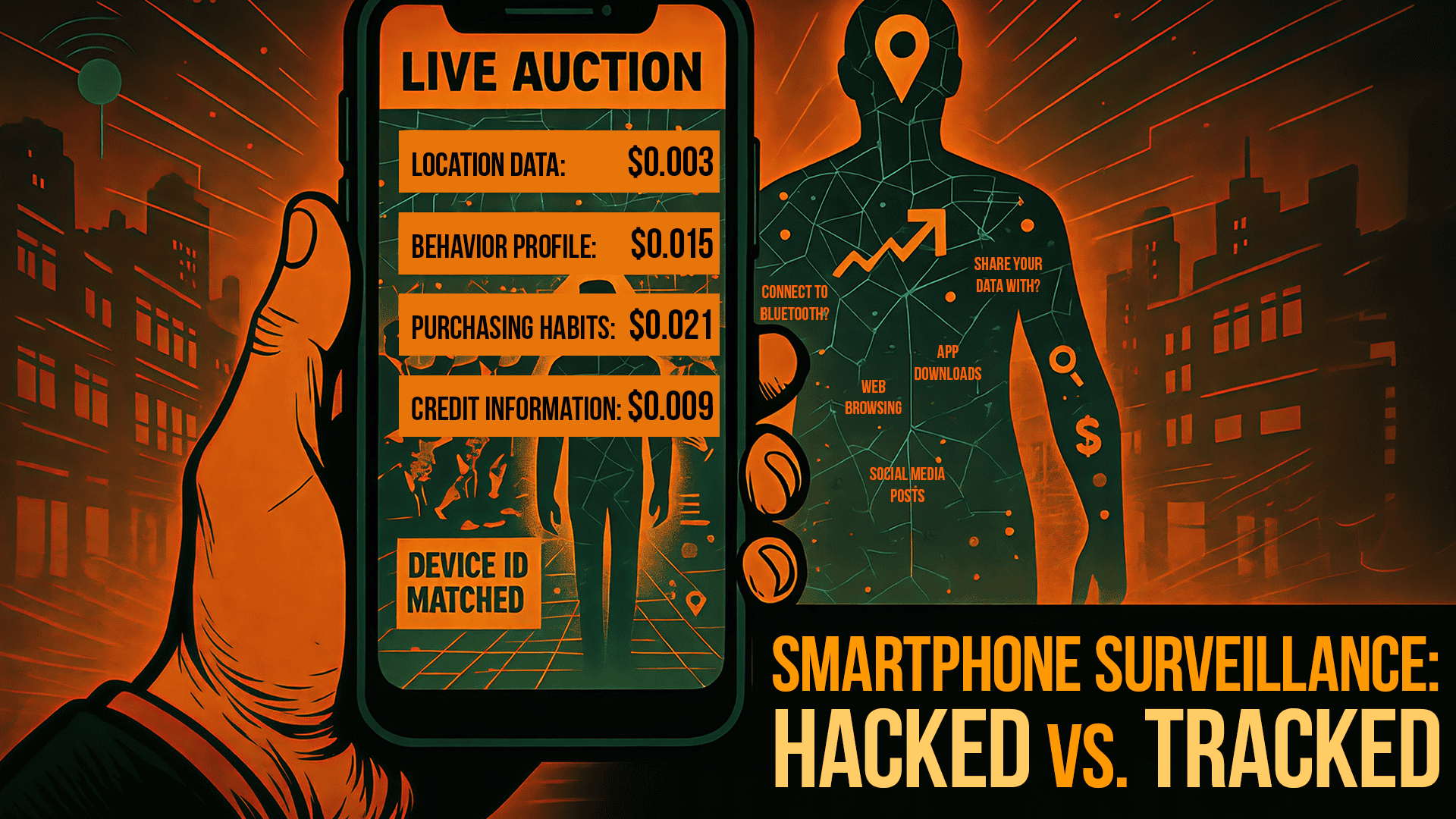
When you open a mobile app, an automated process called real-time bidding (RTB) may be triggered. In milliseconds, your device broadcasts metadata—location, identifiers, behavioral signals—to potentially hundreds of advertisers competing for your attention.
Each interaction creates another fragment of your digital identity.
Over time, these fragments aggregate into a detailed profile:
Where you sleep.
Where you work.
Where you travel.
What you believe.
Who you interact with.
This process occurs hundreds of times per day, often without user awareness.
From a cybersecurity perspective, this is the inversion of traditional threat models.
No exploitation required. No persistence mechanism needed. No lateral movement.
The system is the access.
When Surveillance Becomes Intelligence
What elevates this from a privacy issue to a cybersecurity concern is what happens next.
The data doesn’t stay within the advertising ecosystem.
It moves.
Data brokers aggregate, normalize, and resell it. Governments, private firms, and intelligence entities purchase access. The result is a secondary market where behavioral intelligence can be acquired without direct collection.
Recent developments underscore how mainstream this has become:
- In January 2026, U.S. Immigration and Customs Enforcement (ICE) formally explored acquiring adtech-derived location and behavioral datasets to support investigations [scworld.com], [wired.com]
- Federal agencies have acknowledged purchasing commercially available data to conduct law enforcement operations, raising concerns around warrantless surveillance [fedscoop.com]
- Internal documents show government bodies used advertising-derived location data to track mobile devices over time, leveraging the same systems that power targeted ads [gizmodo.com]
This model bypasses traditional legal and technical barriers.
Why hack a device…
when you can buy the data it already emits?
The Expanding Threat Surface
From a cybersecurity standpoint, this creates a different kind of attack surface—one defined not by vulnerabilities, but by exposure.
1. Data as an Attack Vector
The aggregation of location and behavioral data enables highly targeted social engineering.
An attacker doesn’t need access to your system—they need access to your patterns.
2. Re-identification Risk
Advertising datasets are often labeled “anonymous,” but that anonymity is fragile.
A handful of data points—home location, work location, daily routine—can reliably identify individuals.
3. National Security Implications
Adtech-derived data has already been shown capable of exposing sensitive populations, including military personnel and intelligence officers, through routine behavioral patterns. [proton.me]
4. Supply Chain Exposure
Every SDK embedded in an application represents a potential data pipeline.
Trust is delegated—not just to the developer, but to every third party that code communicates with.
The Illusion of Consent
The system persists because it operates under the framework of consent.
Users “agree” to data collection through terms of service.
But in practice, that consent is fragmented, opaque, and often misleading.
- Permissions are bundled
- Data flows are obscured
- Third-party sharing is rarely transparent
Even where regulation exists, it often lags behind the technical reality. Enforcement actions against data brokers have increased, but the underlying model—mass data collection and resale—remains largely intact.
From a risk perspective, consent does not equal control.
Why This Matters to Cybersecurity Professionals
There is a tendency in cybersecurity to prioritize exploit-based threats because they are measurable, actionable, and visible.
But the adtech surveillance ecosystem introduces a different class of risk:
- Persistent, passive collection
- Massive scale, low visibility
- Legally ambiguous but operationally effective
It challenges traditional defensive mindsets.
Firewalls cannot block it.
EDR tools cannot detect it.
Incident response cannot remediate it.
Because it is not a breach.
It is normal operation.
Redefining “Compromise”
If we define compromise strictly as unauthorized access, then much of modern surveillance sits outside cybersecurity’s traditional scope.
But that definition is increasingly insufficient.
When sensitive behavioral data can be:
- Collected without awareness
- Aggregated without constraint
- Purchased without oversight
…then compromise becomes a matter of context, not intrusion.
A system can be technically secure—and still operationally exposed.
Practical Risk Reduction
While complete isolation from the data ecosystem is unrealistic, there are measurable ways to reduce exposure:
High-Impact Controls
- Restrict location permissions to “while using”
- Reset or disable advertising IDs
- Remove unused applications and audit permissions
Strategic Controls
- Favor applications with minimal third-party integrations
- Segment personal and professional device usage
- Implement mobile device management (MDM) policies in enterprise environments
Realistic Expectation
Mitigation reduces signal. It does not eliminate it.
The goal is not invisibility.
It is friction—making tracking less precise, less consistent, and less exploitable.
The Future of Surveillance
The trajectory is clear.
As artificial intelligence accelerates data analysis, the value of behavioral datasets will increase. Insights that once required specialized intelligence capabilities can now be derived from commercial data streams.
Governments are not building these systems.
They are integrating with them.
The private sector is not resisting.
It is monetizing.
And users…often don’t realize they are participating.
Final Thought: Hacked vs. Tracked
Cybersecurity has always been about control: who has it, how it’s obtained, and what can be done with it.
In the traditional model, control is seized through intrusion.
In the modern data ecosystem, control is granted through participation.
That is the shift.
So the next time someone says,“I think my phone was hacked,”
the better question might be:
What data is your device already giving away… and who’s buying it?
After reading this, if you still feel you’ve been hacked… our Digital Forensics team is here to help.